
树
树
树的节点代表集合,树的边代表关系
广度优先遍历
也叫做层序遍历,一层一层来遍历树
使用队列来进行遍历,遍历完当前节点的子节点就弹出该节点
  void bfs(Node *root) //广度优先遍历
  {
      head = tail = 0;
      Queue[tail++] = root;
      while(head<tail)
      {
          Node *node = Queue[head];
          cout << node->key << endl;
          if(node->lchild) Queue[tail++] = node->lchild;
          if(node->rchild) Queue[tail++] = node->rchild;
          head++;
      }
      return;
  }
深度优先遍历
使用栈来实现遍历
先左后右
判断栈顶元素是否有子节点,有子节点则入栈,无子节点则出栈,直到变为空栈
  void dfs(Node *root) //用栈模拟
  {
      if(root == NULL) return;
      int start,end;
      tot += 1;
      start = tot;
      if(root->lchild) dfs(root->lchild); //递归,调用系统栈
      if(root->rchild) dfs(root->rchild); //调用一次函数实质就是入一次栈
      tot += 1;                           //函数返回实质就是出栈
      end = tot;
      cout << root->key << endl;
      return;
  }
二叉树性质
- 度为0的节点比度为2的节点多一个
- 种类
- 完全二叉树:只有最后一层缺少右侧节点
- 对于编号为i的节点
- 该节点左节点:2*i
- 该节点右节点:2*i+1
- 其编号连续,可以用连续的数组存储
- 对于编号为i的节点
- 满二叉树:没有度为1的节点
- 完美二叉树:每一层都是满的
- 完全二叉树:只有最后一层缺少右侧节点
- 遍历
| 前序遍历 | 中序遍历 | 后序遍历 |
|---|---|---|
| 根左右 | 左根右 | 左右根 |
- 实现树的序列化
- 前加后不能还原,因为不能判断有多少节点
二叉树线索化
有利于让二叉树的遍历方式由递归变为非递归
本质上是利用冗余的指针空间
- 左指针指向前驱
- 右指针指向后继
前驱指的是在相应遍历方式下某节点的前一个节点
后继指的是在相应遍历方式下某节点的后一个节点
      #include<bits/stdc++.h>
      using namespace std;
      void build_inorder_thread(Node *root)
      {
          if(root == NULL) return ;
          if(root->ltag == 0) build_inorder_thread(root->lchild);
          if(inorder_root == NULL) inorder_root = root; //root
          是中序遍历的第一个节点,赋值给inorder_root
          if(root->lchild == NULL) //前驱
          {
              root->lchild = prenode;
              root->ltag = 1;
          }
          if(prenode && prenode->rchild == NULL) //后继
          {
              prenode->rchild = root;
              prenode->rtag = 1;
          }
          prenode = root;  //更新prenode,让其指向当前已经处理完
          毕的节点
          if(root->rtag == 0) build_inorder_thread(root->rchild);
          return;
      }

      void __build_inorder_thread(Node *root)
      {
          build_inorder_thread(root);
          prenode->rchild = NULL; //处理完前面所有节点后,prenode指向最后一个节点
          prenode->rtag = 1;
          return;
      }

      Node *getnext(Node *root)
      {
      if(root->rtag == 1) return root->rchild; //要注意的是,线
      索化的实现是按照中序遍历的顺序来的
          root = root->rchild;         //代码到这一行说明root的
          后继是一条实实在在的边,而在中序遍历中,当前节点的后继是这
          个节点右子树的最左边的节点,因此使用循环遍历
          while(root->ltag == 0 && root->lchild) //当root->tag
          为1时,就说明其没有左子树,因此其就是当前节点右子树的最左
          边的节点
          {
              root = root->lchild;
          }
          return root;
      }
      int main()
      {
          Node *node = inorder_root; //要指向中序遍历的第一个节点
          while(node)
          {
          cout << node->key << " ";
          node = getnext(node);
          }
          clear(root);
          return 0;
      }
使用的方法是站在每个节点的下一个节点去处理当前节点的后继
对于最后一个节点,由于其没有下一个节点,因此无法处理其后继
二叉树与广义表
二叉树转广义表
#include<bits/stdc++.h>
using namespace std;
#define KEY(n) (n ? n->key : -1) //空地址返回负一

typedef struct Node
{
    int key;
    struct Node *lchild,*rchild;
}Node;

Node *getnewnode(int key)
{
    Node *p = new Node;
    p->key = key;
    p->lchild = p->rchild = NULL;
    return p;
}

void clear(Node *root)
{
    if(root == NULL)  return ;
    clear(root->lchild);
    clear(root->rchild);
    delete root;
    return ;
}

Node *insert(Node *root,int key)
{
    if(root == NULL) return getnewnode(key);
    if(rand()%2) root->lchild = insert(root->lchild,key);
    else root->rchild = insert(root->rchild,key);
    return root;
}

Node *getranderbinarytree(int n)
{
    Node *root =NULL;
    for(int i = 0;i < n;i++)
    {
        root = insert(root,rand() % 100);
    }
    return root;
}

char buff[1000];
int len = 0; //广义表信息长度

void __serialize(Node *root) //使用前序遍历序列化
{
    if(root == NULL) return;
    len += sprintf(buff + len ,"%d",root->key);//sprintf的返回值是输出的字符数
    if(root->lchild == NULL && root->rchild == NULL) return;
    len += sprintf(buff + len ,"(");
    __serialize(root->lchild);
    if(root->rchild)
    {
        len += sprintf(buff + len ,",");
        __serialize(root->rchild);
    }
    len += sprintf(buff + len ,")");
    return ;
}

void serialize(Node *root)
{
    memset(buff,0,sizeof(buff));
    len = 0;
    __serialize(root);
    return;
}


void print(Node *node)
{
    printf("%d(%d,%d)\n",KEY(node),KEY(node->lchild),KEY(node->rchild));
    return ;
}

void output(Node *root)
{
    if(root == NULL) return;
    print(root);
    output(root->lchild);
    output(root->rchild);
    return;
}
int main()
{
    srand((unsigned)time(NULL));
    #define n 10
    Node *root = getranderbinarytree(n);
    serialize(root);
    output(root);
    cout << buff << " " <<"广义表";
    clear(root);
    return 0;
}
广义表转二叉树
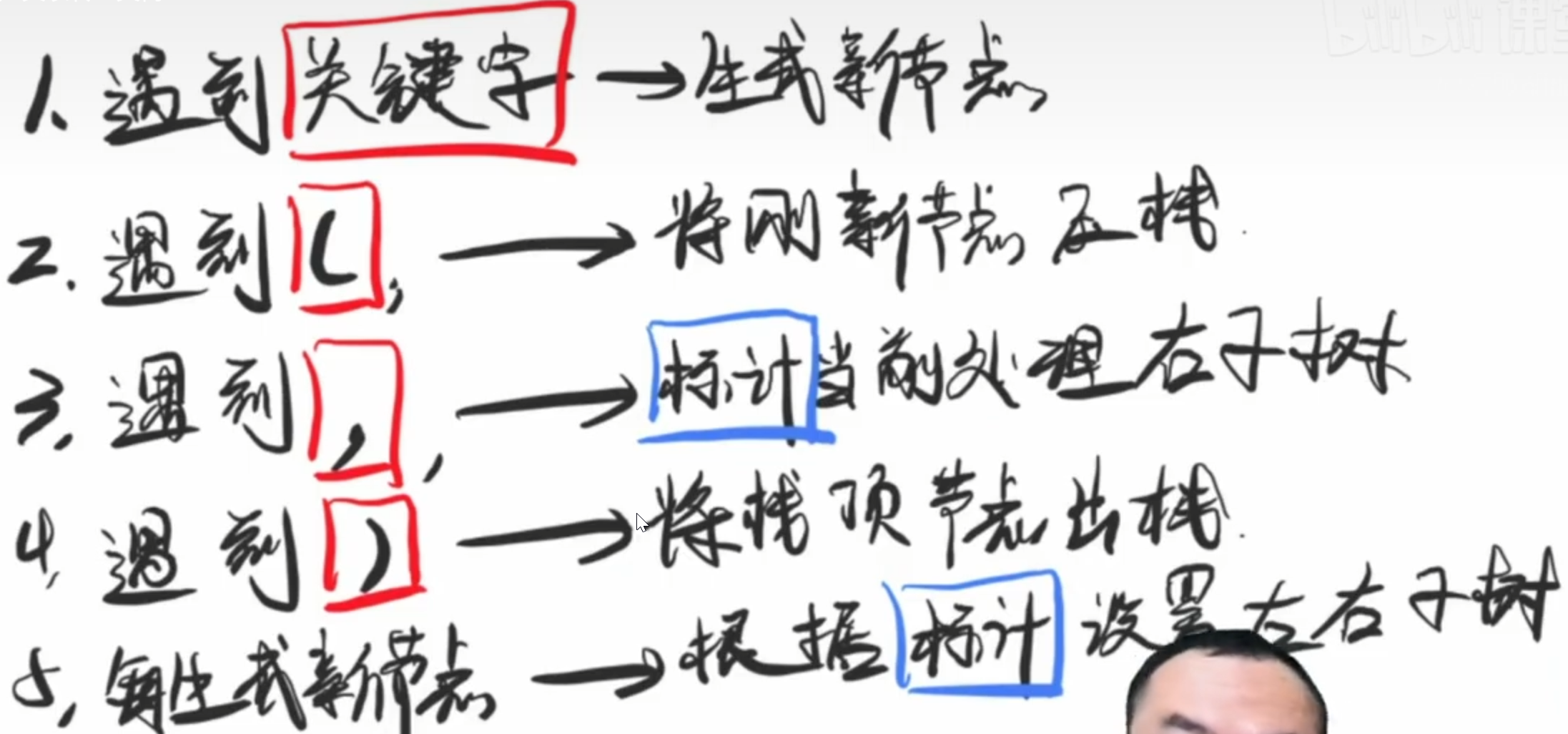
运用栈的思想
- 遇到关键字,生成节点
- 碰到左括号入栈
- 碰到逗号标记flag为1(flag为0代表左子树,为1代表右子树)
- 碰到右括号弹栈
设立左右子树时是为栈顶元素设立的
这道题使用状态机的算法思想,使用对应数字来分配任务
但分配完任务i须减1,同样地,完成任务后scode要设置为0#include<bits/stdc++.h> using namespace std; #define KEY(n) (n ? n->key : -1) //空地址返回负一 typedef struct Node { int key; struct Node *lchild,*rchild; }Node; Node *getnewnode(int key) { Node *p = new Node; p->key = key; p->lchild = p->rchild = NULL; return p; } void clear(Node *root) { if(root == NULL) return ; clear(root->lchild); clear(root->rchild); delete root; return ; } Node *insert(Node *root,int key) { if(root == NULL) return getnewnode(key); if(rand()%2) root->lchild = insert(root->lchild,key); else root->rchild = insert(root->rchild,key); return root; } Node *getranderbinarytree(int n) { Node *root =NULL; for(int i = 0;i < n;i++) { root = insert(root,rand() % 100); } return root; } char buff[1000]; int len = 0; //广义表信息长度 void __serialize(Node *root) //使用前序遍历序列化 { if(root == NULL) return; len += sprintf(buff + len ,"%d",root->key);//sprintf的返回值是输出的字符数 if(root->lchild == NULL && root->rchild == NULL) return; len += sprintf(buff + len ,"("); __serialize(root->lchild); if(root->rchild) { len += sprintf(buff + len ,","); __serialize(root->rchild); } len += sprintf(buff + len ,")"); return ; } void serialize(Node *root) { memset(buff,0,sizeof(buff)); len = 0; __serialize(root); return; } Node *deserialize(char *buff,int n) { Node **s = (Node **)malloc(sizeof(Node *) * 100); int top = -1,flag = 0,scode = 0; //这里使用了状态机的算法思维 Node *p = NULL , *root =NULL; for(int i = 0 ; buff[i];i++) { switch(scode) { case 0: { if(buff[i] >= '0' && buff[i] <= '9') scode = 1; else if(buff[i] == '(') scode = 2; else if(buff[i] == ',') scode = 3; else scode = 4; i -= 1; } break; case 1: { int num = 0; while(buff[i] <= '9' && buff[i] >= '0') { num = num * 10 +(buff[i] - '0'); i += 1; } p = getnewnode(num); if(top >= 0 && flag == 0) s[top]->lchild = p; if(top >= 0 && flag == 1) s[top]->rchild = p; i -= 1; //得到num后,i会指向下一个位置,但外层循环有i+1,为抵消影响,在这i-1 scode = 0; } break; case 2: { s[++top] = p; flag = 0; scode = 0; } break; case 3: { flag = 1; scode = 0; } break; case 4: { root = s[top--]; scode = 0; } break; } } return root; } void print(Node *node) { printf("%d(%d,%d)\n",KEY(node),KEY(node->lchild),KEY(node->rchild)); return ; } void output(Node *root) { if(root == NULL) return; print(root); output(root->lchild); output(root->rchild); return; } int main() { srand((unsigned)time(NULL)); #define n 10 Node *root = getranderbinarytree(n); serialize(root); output(root); cout << buff << " " <<"广义表"; Node *new_root = deserialize(buff,len); output(new_root); clear(root); return 0; }
哈夫曼编码
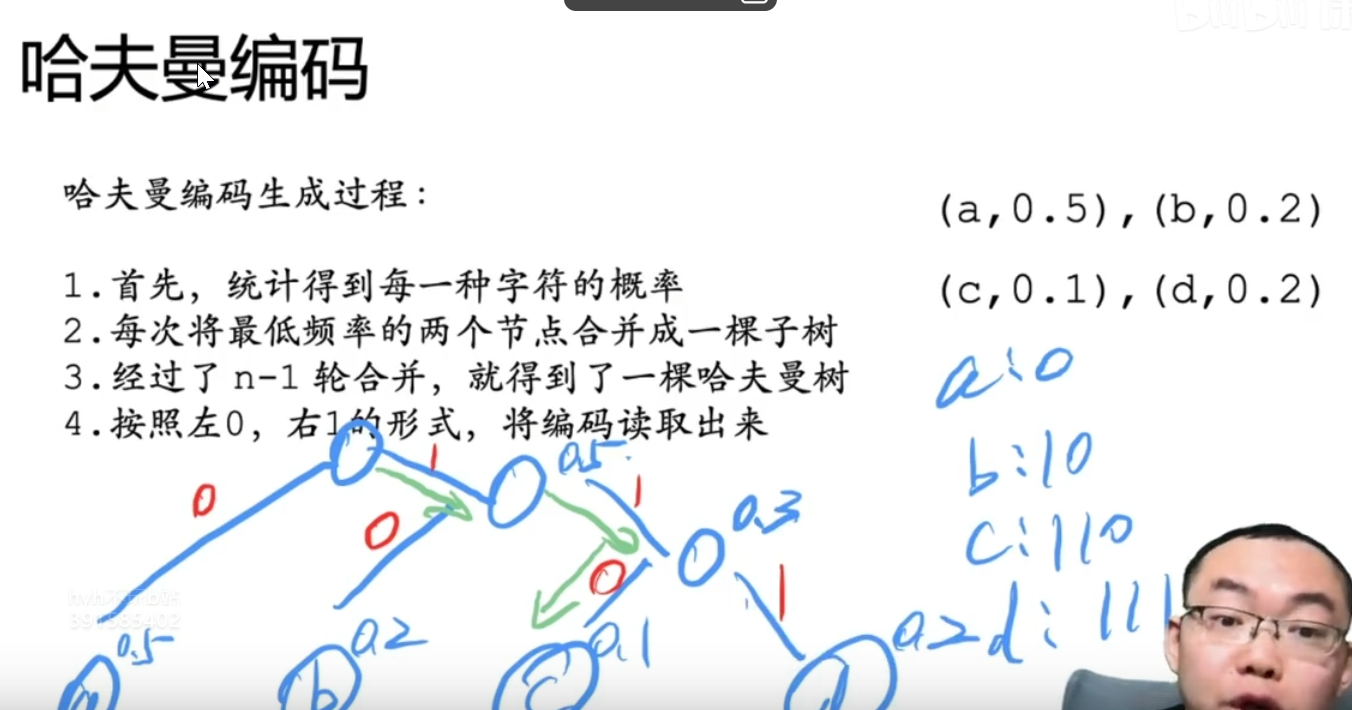
两个字符编码不能形成前缀关系
#include<bits/stdc++.h>
using namespace std;
typedef struct Node
{
    int freq;
    char ch;
    struct Node *lchild,*rchild;
}Node;

Node *getnewnode(int freq,char ch)
{
    Node *p = new Node;
    p->ch = ch;
    p->freq = freq;
    p->lchild = p->rchild = NULL;
    return p;
}


void swap_node(Node **node_arr,int i,int j)
{
    Node *temp = node_arr[i];
    node_arr[i] = node_arr[j];
    node_arr[j] = temp;
    return;
}

int find_min_node(Node **node_arr,int n)
{
    int ind = 0;
        for(int j = 1;j <= n;j++)
        {
            if(node_arr[ind]->freq > node_arr[j]->freq) ind = j;
        }
    return ind;
}
//重难点:哈夫曼树建立过程
Node *buildhaffmantree(Node **node_arr,int n)
{
    for(int i = 1;i < n;i++)
    {
        int ind1 = find_min_node(node_arr,n - i);
        swap_node(node_arr,ind1,n-i); //将最小值与当前最后一个节点交换位置
        int ind2 = find_min_node(node_arr,n - i - 1);
        swap_node(node_arr ,ind2,n - i - 1);
        int freq = node_arr[n - i]->freq + node_arr[n - i - 1]->freq;
        Node *node = getnewnode(freq , 0);
        node->lchild = node_arr[n - i];
        node->rchild = node_arr[n- i - 1];
        node_arr[n - i - 1] = node;
    }
    return node_arr[0];
}

void extracthaffmancode(Node *root ,char buff[],int k)
{
    buff[k] = 0;
    if(root->lchild == NULL && root->rchild == NULL)
    {
        cout << root->ch << buff << endl;
        return ;
    }
    buff[k] = '0';
    extracthaffmancode(root->lchild,buff,k+1);
    buff[k] = '1';
    extracthaffmancode(root->rchild,buff,k+1);
    return ;
}
void clear(Node *root)
{
    if(root = NULL) return ;
    clear(root->lchild);
    clear(root->rchild);
    delete root;
    return ;
}


int main()
{
    int n,freq;
    char s[10];
    cin >> n;
    Node **node_arr = new Node *[n];
    for(int i = 0;i < n;i++)
    {
        cin >> s >> freq;
        node_arr[i] = getnewnode(freq,s[0]);
    }
    Node *root = buildhaffmantree(node_arr,n);
    char buff[1000];
    extracthaffmancode(root,buff,0);
    clear(root);
    return 0;
}
n叉树前序遍历
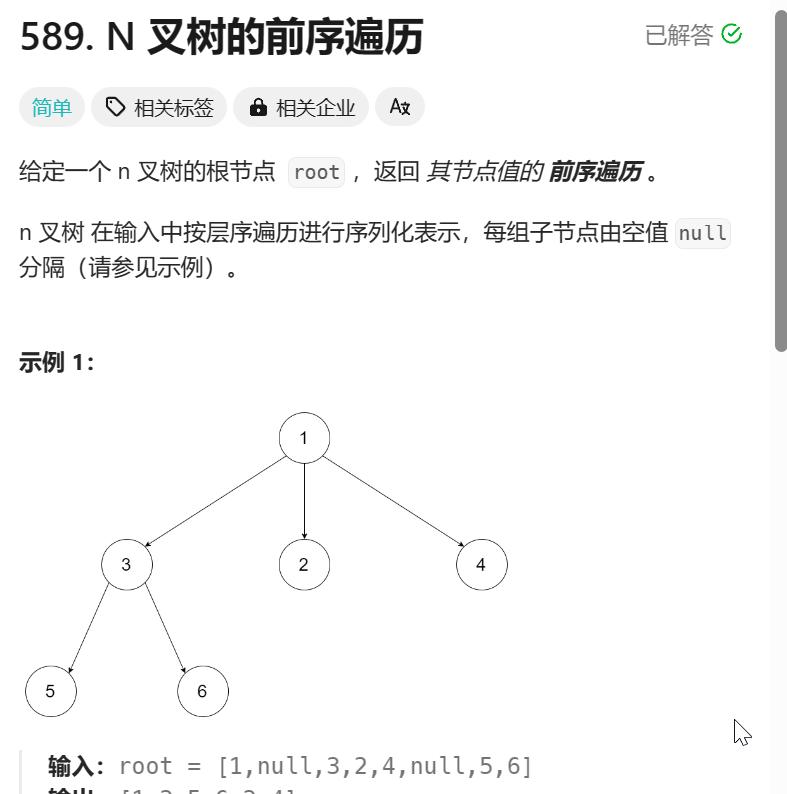
/*
// Definition for a Node.
class Node {
public:
int val;
vector<Node*> children;
    Node() {}

    Node(int _val) {
        val = _val;
    }

    Node(int _val, vector<Node*> _children) {
        val = _val;
        children = _children;
    }
};
*/

class Solution {
public:
    vector<int> preorder(Node* root) {
    if(root == NULL) return vector<int>();
    vector<int> ans;
    ans.push_back(root->val);
    for(auto x: root->children)
    {
        vector<int> temp = preorder(x);
        for(auto y : temp) ans.push_back(y);
    }
    return ans;
    }
};
从前序与中序遍历序列构造二叉树
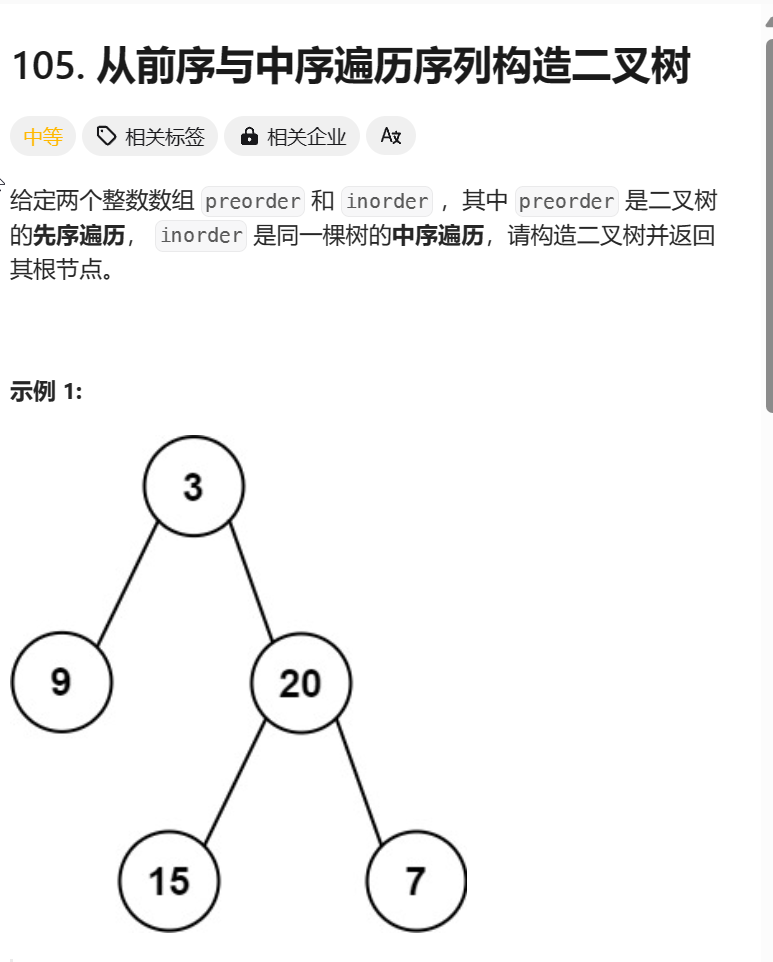
- 使用递归思想
- 对大树使用前序与中序遍历结果恢复二叉树
对左右子树也分别用前中序遍历结果恢复
返回根节点
  class Solution {
  public:
      TreeNode* buildTree(vector<int>& preorder, vector<int>& inorder) {
      if(preorder.size() == 0) return NULL;
      int pos = 0;
      while(inorder[pos] != preorder[0]) pos += 1;
      TreeNode *root = new TreeNode(preorder[0]);
      vector<int> pre , in;
      for(int i = 1;i <= pos;i++) pre.push_back(preorder[i]);
      for(int i = 0;i <= pos -1;i++) in.push_back(inorder[i]);
      root->left = buildTree(pre,in);
      pre.clear();
      in.clear();
      for(int i = pos + 1;i < preorder.size();i++)
      {
      pre.push_back(preorder[i]);
      in.push_back(inorder[i]);
      }
      root->right = buildTree(pre,in);
      return root;
      }
  };
二叉树的层序遍历
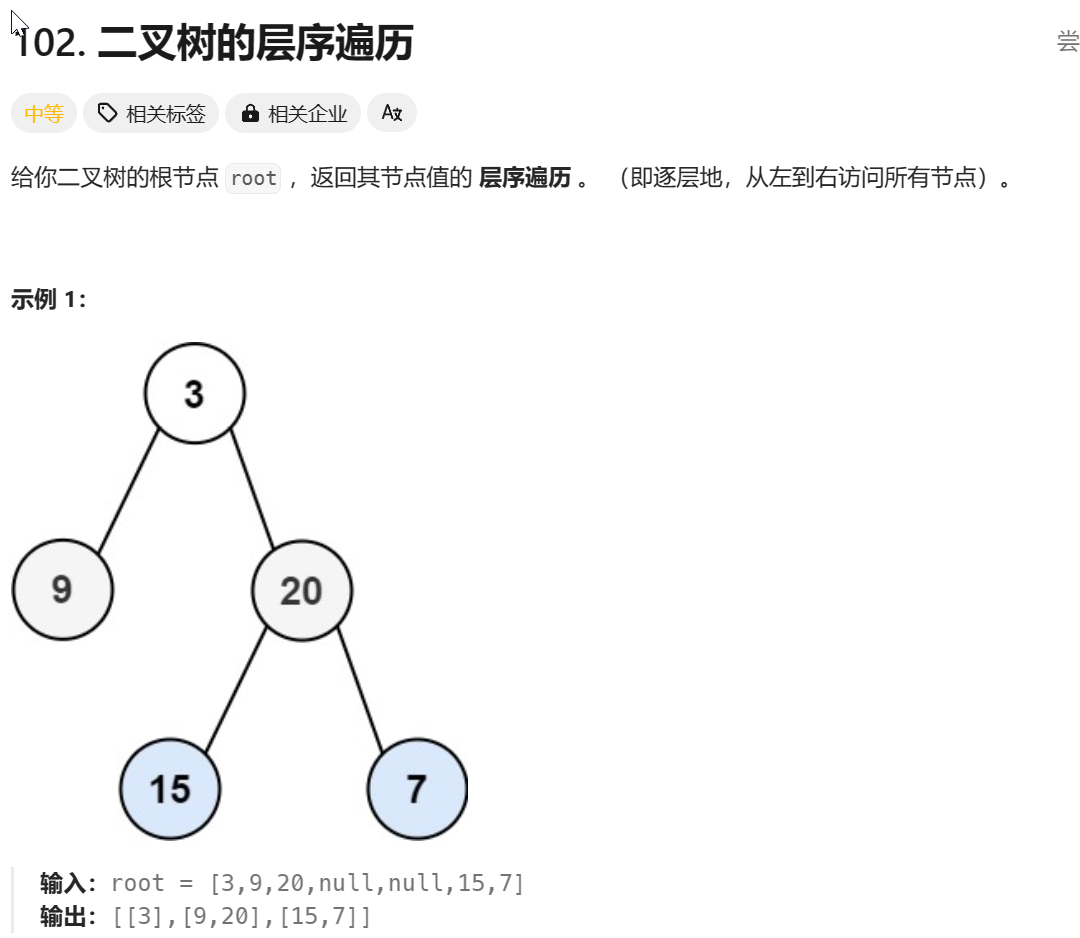
广搜
class Solution {
public:
    vector<vector<int>> levelOrder(TreeNode* root) {
    if(root == NULL) return vector<vector<int>>();
    TreeNode *node;
    queue<TreeNode *> q;
    q.push(root);
    vector<vector<int>> ans;
    while(!q.empty())
    {
        int cnt = q.size();
        vector<int> temp;
        for(int i = 0;i < cnt;i++)
        {
            node = q.front();
            temp.push_back(node->val);
            if(node->left) q.push(node->left);
            if(node->right) q.push(node->right);
            q.pop();
        }
        ans.push_back(temp);
    }
    return ans;
}
};
深搜
深搜的精髓是要找到当前节点的层数,并在相应二维数组的一维数组的位置插入数值
要记得在相应层数扩充一维数组
  class Solution {
      void dfs(TreeNode *root,int k,vector<vector<int>> &ans)
      {
          if(root == NULL) return ;
          if(k == ans.size()) ans.push_back(vector<int>());
          ans[k].push_back(root->val);
          dfs(root->left,k+1,ans);
          dfs(root->right,k+1,ans);
          return ;
      }
  public:
      vector<vector<int>> levelOrder(TreeNode* root) {
      vector<vector<int>> ans;
      dfs(root,0,ans);
      return ans;
  }
  };
翻转二叉树
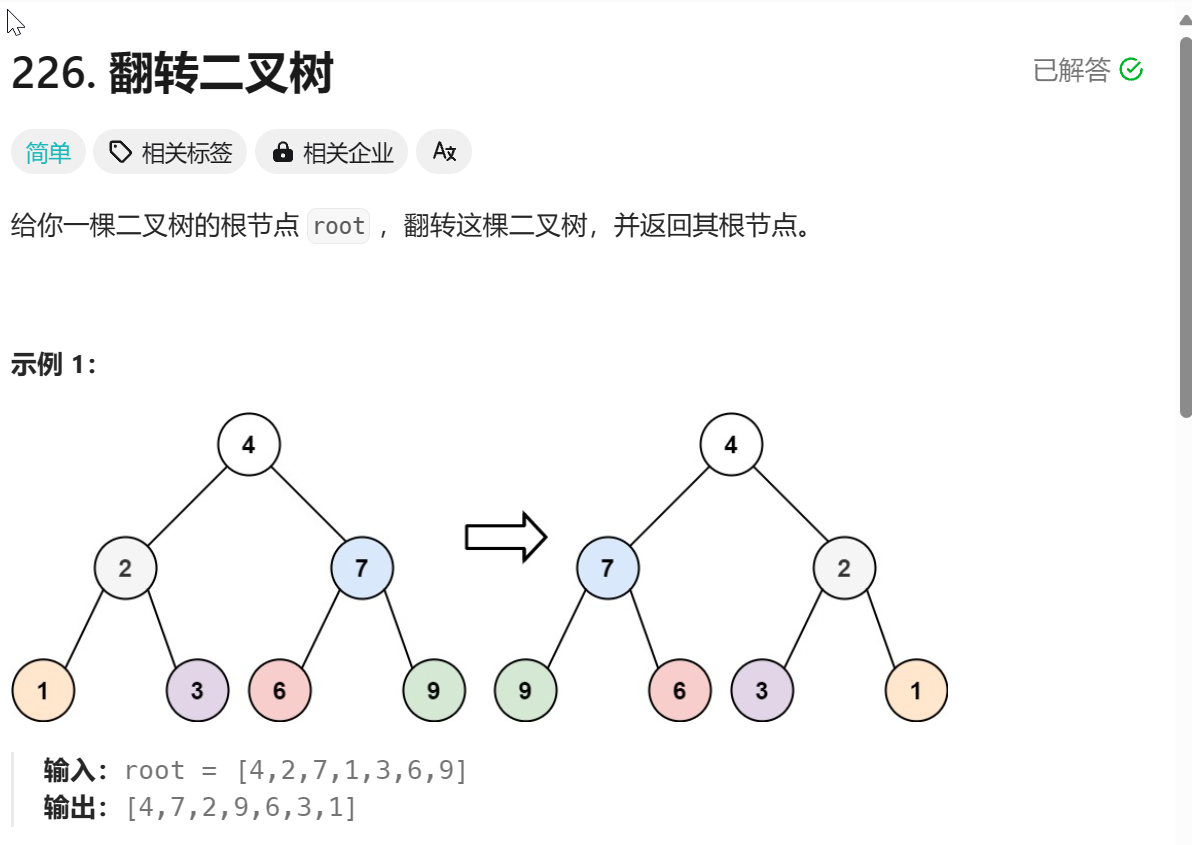
利用递归思想 解决完当前根节点的子节点 就解决子节点的子节点
可以利用c++里面的swap函数,不需要手写交换函数
  class Solution {
  public:
      TreeNode* invertTree(TreeNode* root) {
          if(root == NULL) return NULL;
          swap(root->right,root->left);
          invertTree(root->left);
          invertTree(root->right);
          return root;
      }
  };
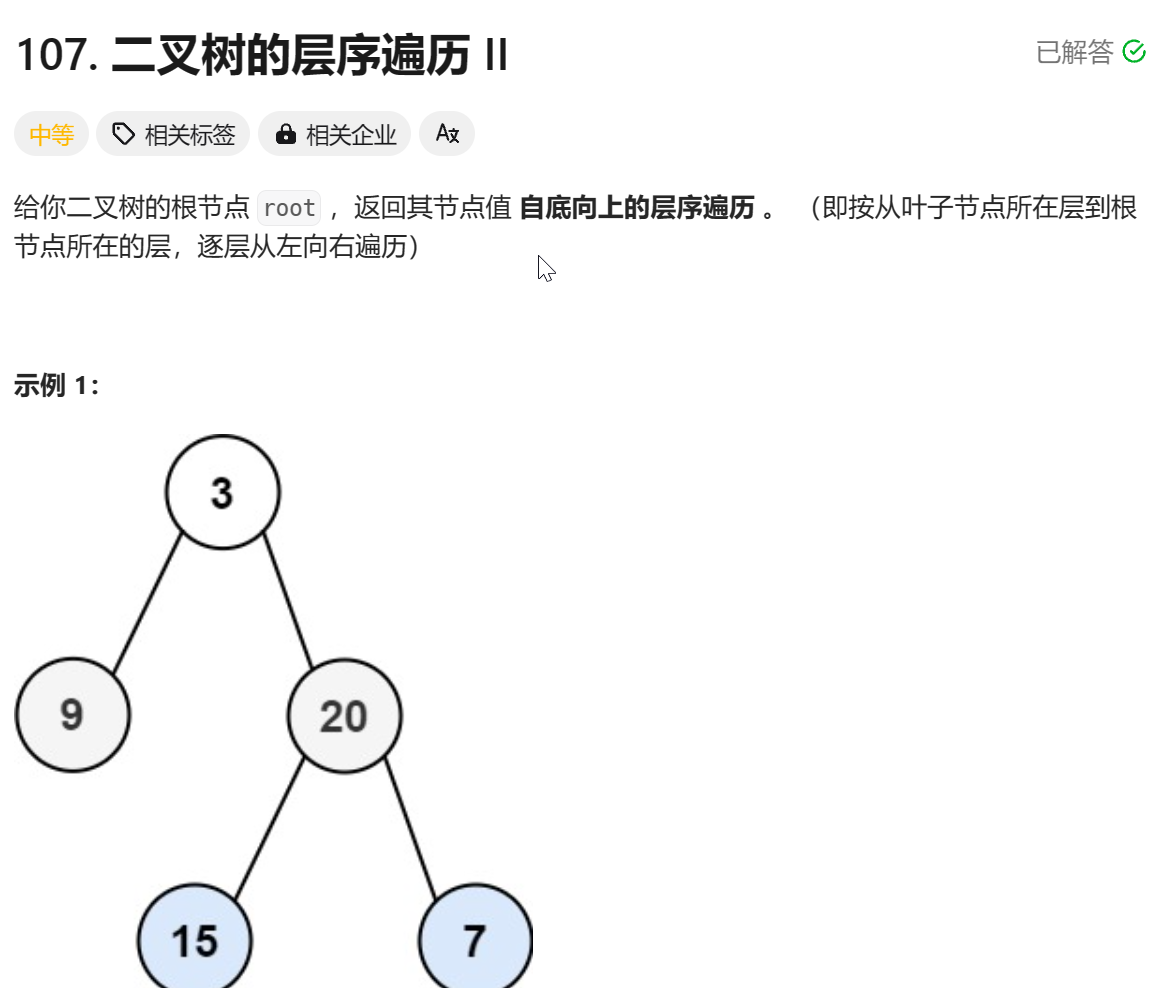
二叉树层序遍历
    class Solution {
    public:
        void dfs(TreeNode *root,int k,vector<vector<int>> &ans)
        {
            if(root == NULL) return;
            if(k == ans.size()) ans.push_back(vector<int>());
            ans[k].push_back(root->val);
            dfs(root->left,k+1,ans);
            dfs(root->right,k+1,ans);
            return ;
        }
        vector<vector<int>> levelOrderBottom(TreeNode* root){
            vector<vector<int>> ans;
            dfs(root,0,ans);
            for(int i = 0,j = ans.size()-1;i < j;i++,j--)
            {
                swap(ans[i],ans[j]);
            }
        return ans;
        }
    };
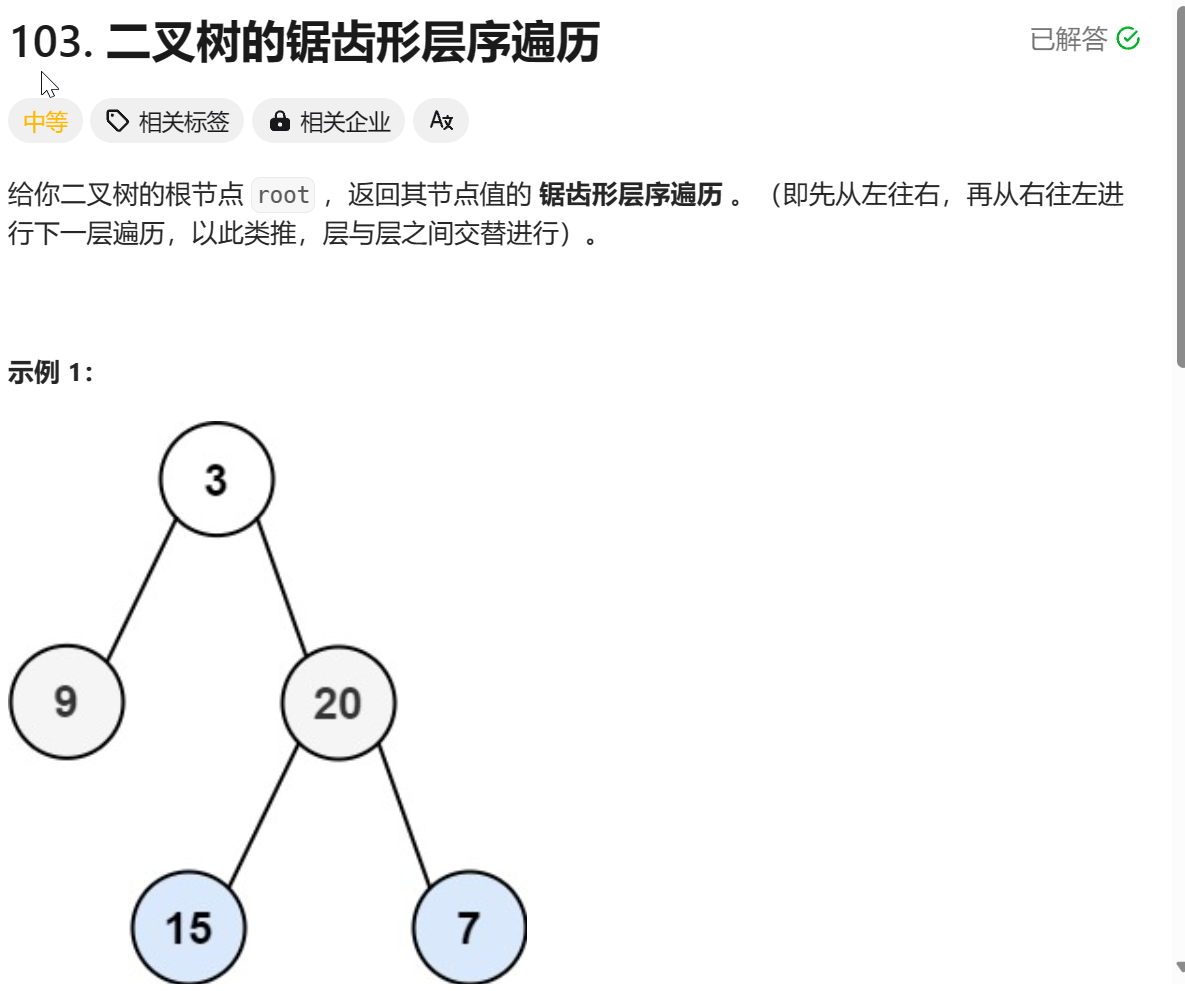
二叉树的锯齿形层序遍历
    class Solution {
    public:
        void dfs(TreeNode *root,int k,vector<vector<int>> &ans)
            {
            if(root == NULL) return;
            if(k == ans.size()) ans.push_back(vector<int>());
            ans[k].push_back(root->val);
            dfs(root->left,k+1,ans);
            dfs(root->right,k+1,ans);
            return ;
            }
        vector<vector<int>> zigzagLevelOrder(TreeNode* root){
            vector<vector<int>> ans;
            dfs(root,0,ans);
            for(int k = 1;k < ans.size();k+=2)
            {
                for(int i = 0,j = ans[k].size()-1;i < j;i++,j--)
                swap(ans[k][i],ans[k][j]);
            }
            return ans;
        }
    };
合并果子

哈夫曼编码的应用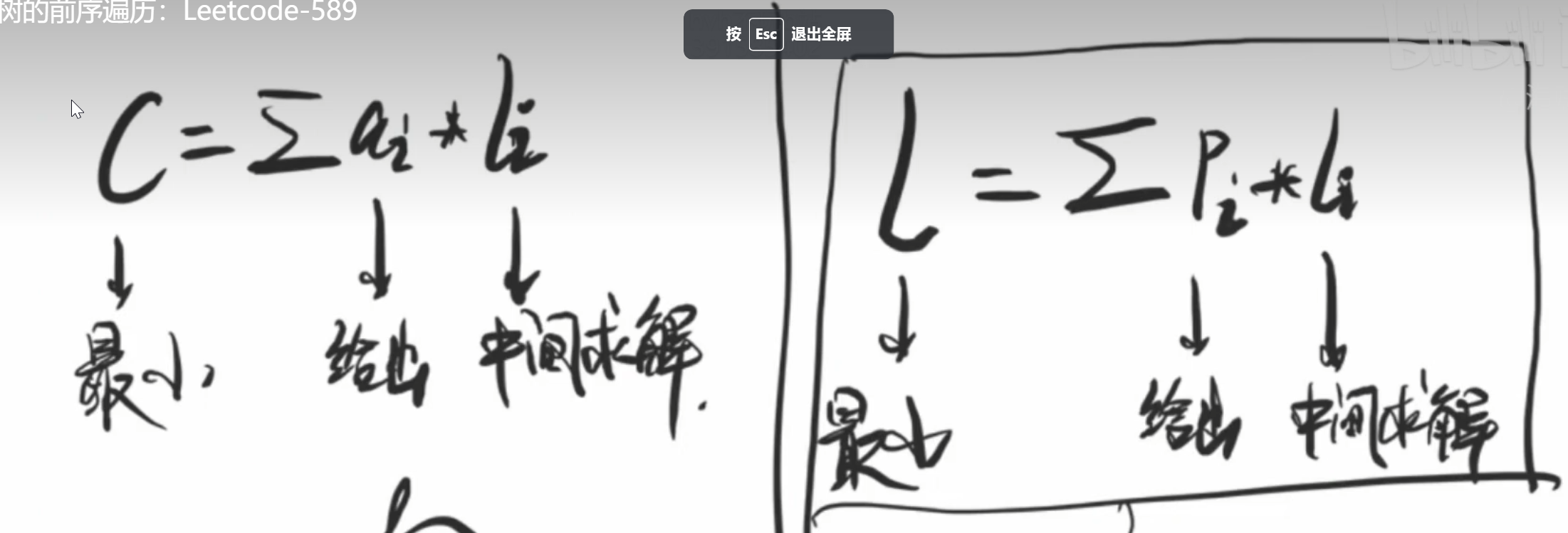
最优体力是堆的数量乘以路径长度(个人理解是层数)
与哈夫曼算法本质是一样的
这里用到了set类模板 要使用pair才可以存储键值对
先找出最小的,将其删除,再找出次小的,再删除,然后将这两堆合并,合并次数为n-1次
  #include<bits/stdc++.h> //合并果子 海贼oj287
  using namespace std;
  typedef pair<int,int> PII;
  int main()
  {
      int n;
      set<PII> s;
      cin >> n;
      for(int i = 0,a;i < n;i++)
      {
          cin >> a;
          s.insert(PII(a,i));
      }
      int ans = 0;
      for(int i = 1;i < n;i++)
      {
          int a = s.begin()->first;
          s.erase(s.begin());
          int b = s.begin()->first;
          s.erase(s.begin());
          ans += a+b;
          s.insert(PII(a + b,n + i));
      }
      cout << ans;
      return 0;
  }
货仓选址

分析
设货仓建在x坐标,x左侧商店有P家,x右侧商店有Q家。若P < Q,则每把货仓的选址向右移动1单位距离,距离之和就会变小Q - P(左侧的P家店到x的距离增加P,因为每家店到x的距离都增加了1单位距离,右侧的Q家店到x的距离减少Q,而P < Q,因此距离减少了Q - P),若P > Q ,同理可证明距离增加了P - Q
因此当货仓在所有位置的中位数时,距离之和最小
    #include<bits/stdc++.h> //海贼oj245 货仓选址
    using namespace std;
    int main()
    {
        int n;
        vector<int> arr;
        cin >> n;
        for(int i = 0,a;i < n;i++)
        {
            cin >> a;
            arr.push_back(a);
        }
        sort(arr.begin(),arr.end());
        int p = arr[n/2],ans = 0;//n不论奇偶n/2都是中位数
        for(int i = 0;i < n;i++)
        {
            ans += abs(arr[i] - p);
        }
        cout << ans;
        return 0;
    }