
基础算法
| 类型 | 范围 |
|---|---|
| int | |
| long long |
基本单位
| 基本单位 | 详解 |
|---|---|
| Bit(比特) | 计算机中最小数据单位,表示二进制的一位 |
| Byte(字节) | 计算机存储的基本单位,1 Byte = 8 Bits |
快速排序
- 确定分界点
- 重点:调整区间,根据分界点重新划分数据分布,保证左边数小于分界点,右边数大于分界点
- 暴力做法:
- 创建两个数组a,b
- 扫描原数组,小于分界点的数放到a,大于分界点的数放到b
- 然后再把a和b里面的数放回原数组
- 优雅做法(双指针):
- 创建两个指针l、r,分别直指向数组的头部和尾部
- l从左边开始向右扫描,碰到大于等于分界点的数就停下来
- r从右边开始向左扫描,碰到小于等于分界点的数就停下来
- 交换两个指针指向的数,然后各自移动1位
- 直到l和r相遇
- 暴力做法:
- 递归处理左右两端
##include<iostream>
using namespace std;
const int N = 1e6 + 10;

int n;
int q[N];

void quick_sort(int q[],int l,int r){
    if(l >= r) return;
    int x = q[(int)((l + r) / 2)];
    int i = l - 1 ,j = r + 1;
    while(i < j){
        do i++; while(q[i] < x);
        do j--; while(q[j] > x);
        if(i < j) swap(q[i],q[j]);
	}
    quick_sort(q,l,j);
    quick_sort(q,j + 1,r);
}

int main(){
    scanf("%d", &n);
    for(int i = 0;i < n;i++) scanf("%d",&q[i]);

    quick_sort(q,0,n - 1);

    for(int i = 0;i < n;i++) printf("%d ",q[i]);

    return 0;
}
归并排序
- 时间复杂度:
- 确定分离点:
- 递归排序数组左部分和右部分
- 归并排序完的数组,合二为一
- 用双指针,分别指向两个已排序好的数组的第一位
- 比较指针指向的数,更小的数写入答案数组
- 当访问完任意一个数组后退出循环
##include<iostream>
using namespace std;

const int N = 1e6 + 10;
int n;
int q[N],temp[N];

void merge_sort(int q[],int l,int r){
	if(l >= r) return;
    int mid  = (l + r) / 2;
    merge_sort(q, l, mid);
    merge_sort(q, mid + 1, r);

    int k = 0,i = l,j = mid + 1;
    while(i <= mid && j <= r){
        if(q[i] <= q[j]) temp[k++] = q[i++];
        if(q[i] > q[j]) temp[k++] = q[j++];
	}
    while(i <= mid) temp[k++] = q[i++];
    while(j <= r) temp[k++] = q[j++];

    for(int i = l, j = 0;i <= r;i++,j++) q[i] = temp[j];
}


int main(){
    scanf("%d",&n);

    for(int i = 0;i < n;i++) scanf("%d",&q[i]);

    merge_sort(q,0,n - 1);

    for(int i = 0;i < n;i++) printf("%d ",q[i]);

    return 0;
}
整数二分
// 检查查找的数是否满足性质
bool check(int x){...}

// 查找最小的满足check条件的值
int binary_search1(int l,int r){
	while(l < r){
        int mid = (l + r) / 2;
        if(check(mid)) r = mid;
        else l = mid + 1;
    }
    return l;
}


// 查找最大的满足check条件的值
int binary_search2(int l, int r){
    while(l < r){
        int mid = (l + r + 1) / 2; // 加1是防止死循环
        if(check(mid)) l = mid;
        else r = mid - 1;
    }
    return l;
}
浮点数二分
bool check(double x){}

// 不需要处理边界
double binary_search(double l, double r){
    while(r - l > eps){ // eps表示精度,取决题目对精度要求
        double mid = (l + r) / 2;
        if(check(mid)) r = mid;
        else l = mid;
    }
    return l;
}
高精度
也就是把大整数的每一位存到数组里,个位存到数组的第一个位置,后面以此类推
- 加法:
##include<iostream>
##include<vector>
const int N = 1e6 + 10;
int n;
using namespace std;

vector<int> add(vector<int> &a,vector<int> &b) {//加引用可以提高效率
    vector<int> c;
    int t = 0; //进位
    for(int i = 0;i < a.size() || i < b.size();i++){
        if(i < a.size()) t += a[i];
        if(i < b.size()) t += b[i];
        c.push_back(t % 10);
        t /= 10;
    }
    if(t) c.push_back(1);
    return c
}
int main(){
    string a, b;
    vector<int> A, B;
    cin >> a >> b;
    for(int i = a.size() - 1 ;i >= 0;i--) A.push_back(a[i] - '0');
    for(int i = b.size() - 1 ;i >= 0;i--) A.push_back(b[i] - '0');
    vector<int> c = add(A,B);
    for(int i = c.size() - 1;i >= 0 ;i--) printf("%d",c[i]);
}- 减法:
- :算
- :算
##include<iostream>
##include<vector>
const int N = 1e6 + 10;
int n;
using namespace std;

// 判断A是不是大于等于B
bool cmp(vector<int> &a,vector<int> &b){
    if(a.size() != b.size()) return a.size() > b.size();
    for(int i = a.size() - 1;i >= 0;i++){
        if(a[i] != b[i]) return a[i] > b[i];
    }
    return true;
}


vector<int> sub(vector<int> &a,vector<int> &b){
    vector<int> c;
    int t = 0;
    for(int i = 0; i < a.size();i++){
        t = a[i] - t;
        if(i < b.size()) t -= b[i];
        c.push_back((t + 10) % 10);
        if(t < 0) t = 1;
        else t = 0;
    }
    while(c.size() > 1 && c.back() == 0) c.pop_back();
    return c;
}
int main(){
    String a, b;
    vector<int> A, B;
    cin >> a >> b;
    for(int i = a.size() - 1 ;i >= 0;i--) A.push_back(a[i] - '0');
    for(int i = b.size() - 1 ;i >= 0;i--) B.push_back(b[i] - '0');
    if(cmp(A,B)){
         vector<int> c = sub(A,B);
    for(int i = c.size() - 1;i >= 0 ;i--) printf("%d",c[i]);
    }
    else{
         vector<int> c = sub(B,A);
        printf("-");
    for(int i = c.size() - 1;i >= 0 ;i--) printf("%d",c[i]);
    }
}- 乘法:
vector<int> multi(vector<int> &a,int b){
    vector<int> c;
    int t = 0;
    for(int i = 0;i < a.size();i++){
        t += a[i] * b;
        c.push_back(t % 10);
        t =  t / 10;
    }
    while(t > 0){
        c.push_back(t % 10);
        t /= 10;
    }
    // if(t > 0) c.push_back(t);
    while(c.size() > 1 && c.back() == 0) c.pop_back();
    return c;
}- 除法
每次push_back()的值都不会超过两位数,证明如下
也就是说最大是,最大到9
vector<int> div(vector<int> &a,int b,int &r){
    vector<int> c;
    r = 0;
    for(int i = a.size() - 1;i >= 0;i--){
        r = r * 10 + a[i];
        c.push_back(r / b);
        r %= b;
    }
    while(t > 0){
        c.push_back(t )
    }
    while(c.size() > 1 && c.back() == 0) c.pop_back();
    reverse(c.begin(),c.end());

}
前缀和
- 一维前缀和
给定数组
前缀和数组为
表示的元素总和
int t;
int b[n];
// 令s0 = 0 前缀和数组长度变为 n + 1
void sum(int a[]){
    int t = 0;
	for(int i = 0 ;i <= n;i++){
        b[i] = t;
        t += a[i];
	}
}
二维前缀和
给定二维数组,二维前缀和
二维数组从开始存储
表示在二维数组里,围起来的矩形的所有元素的和
等都是0
int s[M][N];
int main(){
    s[0][0] = 0;
    for(int i = 1;i < n;i++){
        for(int j = 1;j < m;j++){
            scanf("%d",&a[i][j]);
            s[i][j] = s[i][j - 1] + a[i][j] - s[i -1][j - 1] + s[i - 1][j];
        }
    }
}
差分
- 一维差分
给定,构造,使得,则是的差分,是的前缀和
假设我们需要对区间内的全都加上,这时候如果直接扫描时间复杂度是O(N)。但我们可以求的差分,让那么后面的数字都会加上,我们再让,就可以让区间内的a都加上C,而其他地方不变,也适用于给赋初值
- 二维差分
原矩阵:
差分矩阵:
##include<iostream>
using namespace std;

int n,m,q;

const int N = 1010;
int a[N][N],b[N][N];

void insert(int x1,int y1,int x2,int y2,int c){
    b[x1][y1] += c;
    b[x2 + 1][y2 + 1] += c;
    b[x1][y2 + 1] -= c;
    b[x2 + 1][y1] -= c;
}


int main(){
    cin >> n >> m >> q;
    for(int i = 1;i <= n;i++){
        for(int j = 1;j <= m;j++){
            int t;
            cin >> t;
            insert(i,j,i,j,t);
        }
    }
    while(q--){
        int x1,y1,x2,y2,c;
        cin >> x1 >> y1 >> x2 >> y2 >> c;
        insert(x1,y1,x2,y2,c);
    }

    for(int i = 1;i <= n;i++){
        for(int j = 1;j <= m;j++){
           b[i][j] = b[i][j] + b[i - 1][j] + b[i][j - 1] - b[i - 1][j - 1]; // 差分数组直接化为前缀和数组
        }
    }

    for(int i = 1;i <= n;i++){
        for(int j = 1;j <= m;j++){
            cout << b[i][j] << " ";
        }
        cout << endl;
    }
}
双指针算法
可以将优化到
没什么好说的,做题
位运算
n的二进制表示中第k位数字是多少
从0开始算的
- 先把第k位移到最后一位:n >> k
- 看个位是几: n & 1
- n >> k & 1;
- :返回x的**最右边(最后)**一位1和后面的数字
- x = 1010,返回10
- x = 101000,返回1000
x & -x
离散化
将不连续的数字映射成连续的数字
值域跨度很大,但是用到的值很少,用到的值十分稀疏
- 要对原始数据去重
- 用二分找要映射的位置
- 本质上是把数组里面的数映射成数组的下标
区间求和
- alls数组是为了存储需要离散化的点,对其进行去重和排序是为了防止映射错误
- add和query分别存储要插入的数据和搜索的数据
- 最后进行区间搜索的时候要先离散化
##include<iostream>
##include<vector>
##include<algorithm>
using namespace std;

const int N = 3e5 + 10; // 不仅有插入的点,还有查询的点,离散化后的数组的长度要能容纳插入点和查询的点的长度
int a[N],s[N]; // 离散化后用前缀和求解

vector<int> alls; // 所有要离散化的下标


typedef pair<int,int> PII;
vector<PII> add,query;
int n,m;
// x为数轴上的点,返回的是离散化后的结果
int find(int x){
    int l = 0, r = alls.size() - 1;
    while(l < r){
        int mid = l + r >> 1;
        if(alls[mid] >= x) r = mid;
        else l = mid + 1;
    }
    return r + 1;
}

int main(){
    cin >> n >> m;
    // 插入操作
    for(int i = 0;i < n;i++){
        int x, c;
        cin >> x >> c;
        alls.push_back(x);
        add.push_back({x,c});
    }

    // 查找操作
    while(m--){
        int l,r;
        cin >> l >> r;
        query.push_back({l,r});
        alls.push_back(l);
        alls.push_back(r);
    }

    //排序、去重,不然映射出错
    sort(alls.begin(),alls.end());
    alls.erase(unique(alls.begin(),alls.end()),alls.end());

    // 处理插入
    for(auto x: add){
        int t = find(x.first);
        a[t] += x.second;
    }

    // 前缀和
    for(int i = 1;i <= alls.size();i++){
        s[i] = a[i] + s[i - 1];
    }

    // 输出答案
    for(auto x: query){
        int l = find(x.first);
        int r = find(x.second);
        cout << s[r] - s[l - 1] << endl;
    }
}
区间合并
把多个有交集的区间合并成一个区间
- 按区间左端点排序
- 扫描区间,并把区间进行合并
##include<iostream>
##include<algorithm>
##include<vector>
using namespace std;
const int N = 100010;

vector<pair<int,int>> t;

int n;


void merge(vector<pair<int,int>> &s){
    vector<pair<int,int>> temp;
    sort(s.begin(),s.end());
    // 用第一对数据作为初始维护区间
    int l = s[0].first,r = s[0].second;
    for(int i = 1;i < s.size();i++){
        if(s[i].first > r) {
            temp.push_back({l,r});
            l = s[i].first;
            r = s[i].second;
        }
        else r = max(r,s[i].second);// 将两种情况合二为一
    }
    // 循环结束后一定会有一个区间没有被处理,在这里进行处理
    temp.push_back({l,r});
    t = temp;
}


int main(){
    cin >> n;
    while(n--){
        int a,b;
        cin >> a >> b;
        t.push_back({a,b});
    }
    merge(t);
    cout << t.size();
}
数据结构
以数组模拟为主
链表
- 单链表:邻接表(存储树和图)
- e[N]:存的是节点的值
- ne[N]:存的是节点的next指针
- 双链表:每个节点有两个指针
- l[N]:记录节点的左指针
- r[N]:记录节点的右指针
- 邻接表:n个单链表
单链表
##include<iostream>

using namespace std;

const int N = 1000010;
/*
e[N]存的是当前节点的值
ne[N]存的是当前节点的指针
head存的是头节点
idx存的是链表已有节点的个数
*/
int e[N],ne[N];
int head,idx;


void init(){
    head = -1;
    idx = 0;
}

void add_to_head(int c){
    e[idx] = c;
    ne[idx] = head;
    head = idx++;
}

void erase(int k){
    // 处理k为0的情况
    if(k == -1) {
        head = ne[head];
    }
    ne[k] = ne[ne[k]];
}

void add(int x,int c){
    e[idx] = c;
    ne[idx] = ne[x];
    ne[x] = idx++;
}

int main(){
    init();
    int m;
    cin >> m;
    while(m--){
        int k,x;
        char op;
        cin >> op;
        if(op == 'H'){
            cin >> x;
            add_to_head(x);
        }
        else if(op == 'D'){
            cin >> k ;
            erase(k - 1);
        }
        else if(op == 'I'){
            cin >> k >> x;
            add(k - 1,x);
        }
    }
    for(int i = head;i != -1;i = ne[i]){
        cout << e[i] << " ";
    }

}
双链表
##include<iostream>
using namespace std;

const int N = 100010;
int l[N],r[N],e[N];
int idx;
// 令双链表的头节点下标为0,尾节点下标为1
void init(){
    r[0] = 1,l[1] = 0;
    idx = 2;
}
// 模拟的是在k的右侧插入
void add(int k,int x){
    e[idx] = x;
    r[idx] = r[k];
    l[idx] = k;
    l[r[k]] = idx;
    r[k] = idx;
    idx++;
}

void remove(int k){
    l[r[k]] = l[k];
    r[l[k]] = r[k];
}


int main(){
    int m;
    init();
    cin >> m;
    while(m--){
        string op;
        cin >> op;
        int k,x;
        if(op == "L"){
            cin >> x;
            add(0,x);
        }
        else if(op == "R"){
            cin >> x;
            add(l[1],x);
        }
        else if(op == "D"){
            cin >> k;
            remove(k + 1); // 第1个插入的数实际上idx是2
        }
        else if(op == "IL"){
            cin >> k >> x;
            add(l[k + 1],x);
        }else if(op == "IR"){
            cin >> k >> x;
            add(k + 1,x);
        }
    }
    for(int i = r[0];i != 1;i = r[i]){
        cout << e[i] << " ";
    }
}
栈
先进后出
##include<iostream>
using namespace std;

const int N = 100010;
int s[N];
int top;

void init(){
    top = -1;
}

bool isempty(){
    return top == -1;
}

void push(int x){
    s[++top] = x;
}

void pop(){
    top--;
}

int query(){
    return s[top];
}

int main(){
    init();
    int m;
    cin >> m;
    while(m--){
        int x;
        string op;
        cin >> op;
        if(op == "push"){
            cin >> x;
            push(x);
        }
        else if(op == "pop") pop();
        else if(op == "empty"){
            if(isempty()) cout << "YES" << endl;
            else cout << "NO" << endl;
        }
        else if(op == "query") cout << query()<< endl;
    }

}
队列
先进先出
##include<iostream>
using namespace std;

const int N = 100010;
int s[N],top,tail;

void init(){
    top = 0;
    tail = -1;
}

void push(int x){
    s[++tail] = x;
}

bool isempty(){
    return tail < top;
}

void pop(){
    top++;
}

int query(){
    return s[top];
}


int main(){
    int m;
    init();
    cin >> m;
    while(m--){
        int x;
        string op;
        cin >> op;
        if(op == "push"){
            cin >> x;
            push(x);
        }
        else if(op == "pop"){
            pop();
        }
        else if(op == "empty"){
            if(isempty()) cout << "YES" << endl;
            else cout << "NO" << endl;
        }
        else if( op == "query"){
            cout << query() << endl;
        }
    }
}
单调栈和单调队列
单调栈:给定一个序列,求每一个数左边离他最近的数且比它小在什么地方
题解出处: https://www.acwing.com/video/5400/
##include<iostream>

using namespace std;
const int N = 1e5 + 10;
int st[N];
int top = -1;
int n;
// 先用朴素算法模拟,然后找出规律,可以用单调栈求解
int main(){
    cin >> n;
    for(int i = 0;i < n;i++){
        int x;
        cin >> x;
        while(top >= 0 && st[top] >= x) top--;
        if(top != -1) cout << st[top] << " ";
        else cout << -1 << " ";
        st[++top] = x;
    }
}单调队列:求滑动窗口最大值或者最小值
- 用一个单调(双端)队列维护,每一时刻这个单调队列都是有序的,每移动一次输出一次队头元素,本质上和单调栈思想一致,都是把不可能的答案给去掉
##include<iostream>
using namespace std;

const int N = 1e6 + 10;
int a[N],st[N];
int head = 0,tail = -1;
int main(){

    int n,k;
    cin >> n >> k;
    for(int i = 0;i < n;i++){
        cin >> a[i];
    }
    // 求最小值
    for(int i = 0;i < n;i++){
        if( i - k + 1 > st[head]) head ++;
        while(tail >= head && a[st[tail]] >= a[i]) tail--;
        st[++tail] = i;
        if(i >= k - 1) cout << a[st[head]] << " ";
    }
    cout << endl;
    // 求最大值
    head = 0,tail = -1;
    for(int i = 0;i < n;i++){
        if(i - k + 1 > st[head]) head ++;
        while(tail >= head && a[st[tail]] <= a[i]) tail--;
        st[++tail] = i;
        if(i >= k - 1) cout << a[st[head]] << " ";
    }
    cout << endl;
}
队列存值的写法
##include<iostream>

using namespace std;
const int N = 1e6 + 10;
int n,k;
int tail = -1,head = 0;
int q[N],a[N];

int main(){
    cin >> n >> k;
    for(int i = 1;i <= n;i++){
        cin >> a[i];
    }
    for(int i = 1;i <= n;i++){
        if(head <= tail && i > k && q[head] == a[i - k]) head ++;
        while(tail >= head && q[tail] > a[i])  tail --;
        q[++tail] = a[i];
        if(i > k - 1){
             cout << q[head] << " ";
        }
    }
    cout << endl;
    head = 0, tail = -1;
     for(int i = 1;i <= n;i++){
        if(head <= tail && i > k && q[head] == a[i - k]) head ++;
        while(tail >= head && q[tail] < a[i])  tail --;
        q[++tail] = a[i];
        if(i > k - 1){
             cout << q[head] << " ";
        }
    }

}
KMP
- 字符串匹配的一种算法,本质上是根据已有信息减少重复匹配。
- 算法维护一个next数组,存储的是最长的相等真前缀和真后缀的长度。
- 真前缀:只包含首字母,不包含尾字母的所有子串
- 真后缀:只包含尾字母,不包含首字母的所有子串
- 进行next数组初始化时,
i是前缀末尾,j是后缀末尾
- 当前面n个字符匹配成功,但是第
n + 1个字符匹配失败,算法将模式串向右滑动n - next[n]位,再从第n+1位比较
##include<iostream>
using namespace std;

const int N = 1e6 + 10;
char s[N],p[N];
// 字符串是从下标为1开始,当然也可以从0开始,所以第1个字符能移动的距离ne[1]为0
int ne[N];
int main(){
    int n,m;
    cin >> n >> p + 1 >> m >> s + 1;
    /*
    j是存储下标i可以往前移动从而避免重复匹配的下标
        a b a b a
        1 2 3 4 5
    ne  0 0 1 2 3
      a b a b a
          a b a b a
    */
    for(int i = 2,j = 0;i <= n;i++){
        while(j && p[i] != p[j + 1]) j = ne[j];
        if(p[i] == p[j + 1]) j++;
        ne[i] = j;
    }


    for(int i = 1,j = 0; i <= m;i++){
        while(j && s[i] != p[j + 1]) j = ne[j];
        if(s[i] == p[j + 1]) j++;
        if(j == n) {
            // 我们代码的下标是从1开始计数,题目要求从0开始,因此不是i-n+1
            cout << i - n << " ";
            j = ne[j];
        }
    }

}
Trie
高效地存储和查找字符串集合的数据结构
如图所示:
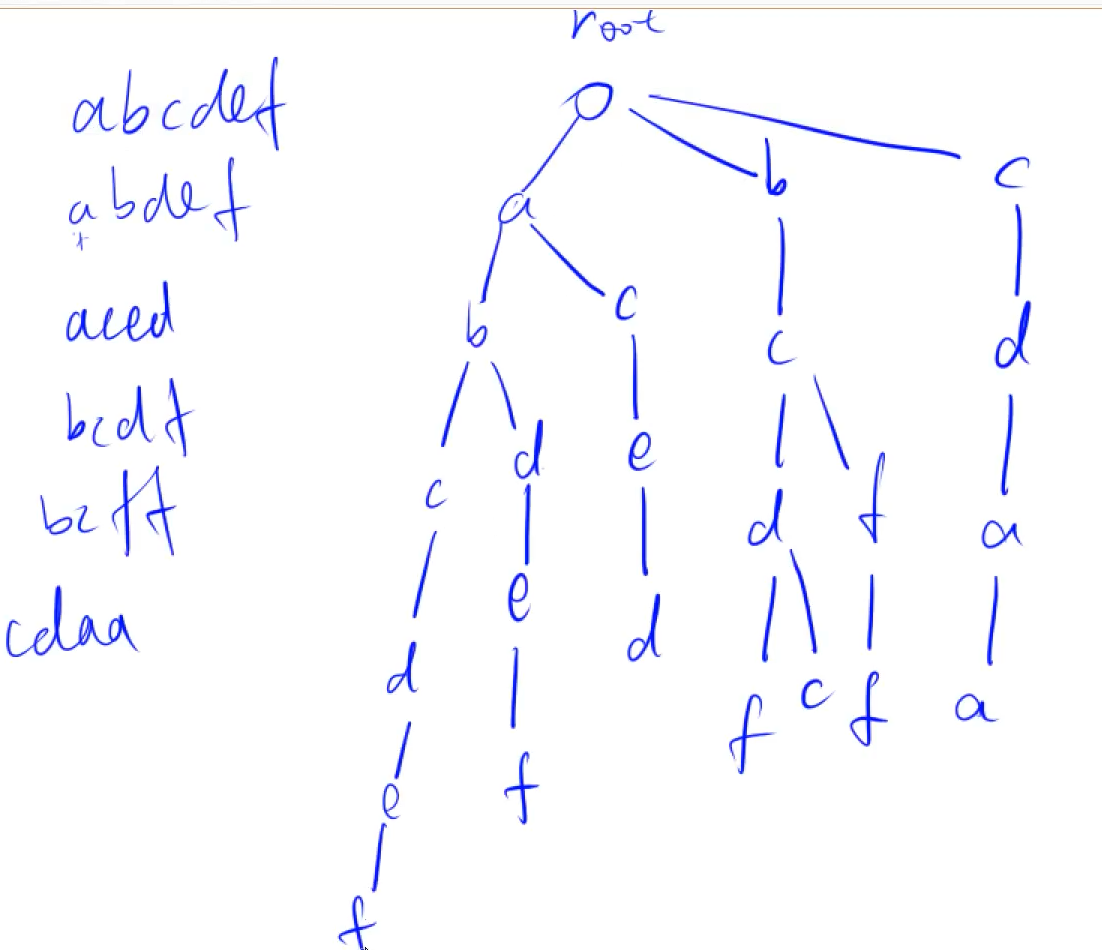
如果某个字符是某个单词结尾,需要在这个字符后打上标记
根节点是空节点,下标(编号)为0
##include<iostream>
##include<string.h>
using namespace std;

const int N = 1e5 + 10;
int son[N][26],idx,cnt[N];
int n;

void insert(char str[]){
    int p = 0;
    for(int i = 0;str[i];i++){
        if(!son[p][str[i] - 'a']) son[p][str[i] - 'a'] = ++idx;
        p = son[p][str[i] - 'a'];
    }
    cnt[p]++;
}

int query(char str[]){

    int p = 0;
    for(int i = 0;str[i];i++){
        if(!son[p][str[i] - 'a']) return 0;
        p = son[p][str[i] - 'a'];
    }
    return cnt[p];
}

int main(){
    ios::sync_with_stdio(false);
    cout.tie(0),cin.tie(0);
    cin >> n;
    while(n--){
        string s;
        char x[N];
        cin >> s;
        if(s == "I"){
            cin >> x;
            insert(x);
        }
        else if(s == "Q"){
            cin >> x;
            cout << query(x) << endl;
        }
    }


}
最大异或对
##include<iostream>
using namespace std;

const int N = 1e5 + 10;
const int M = 31 * N; //用二进制表示最多有31*N个节点
int n;
int a[N],son[M][2];
int idx = 0;
void insert(int x){
    int p = 0;
    for(int i = 30;i >= 0;i--){
        int u = x >> i & 1;
        if(!son[p][u]) son[p][u] = ++idx;
        p = son[p][u];
    }
}

int search(int x){
    int p = 0,res = 0;
    for(int i = 30;i >= 0;i--){
        int u = x >> i & 1;
        if(son[p][!u]){
            p = son[p][!u]; // 要找最大的肯定要找不同的,比如1和0,0和1
            res = res * 2 + 1; //比如100 -> 1001 ,起始就是 (100)_2 * 2 + 1 = (1001)_2 即4 * 2 + 1 = 9
        }
        else {
            p = son[p][u];// 这是因为找不到不同的,但是为了左移只能退而求其次
            res = res * 2;
        }
    }
    return res;
}

int main(){
    scanf("%d",&n);
    int ans = 0;
    for(int i = 0;i < n;i++) {
        scanf("%d",&a[i]);
        insert(a[i]);
    }
    for(int i = 0;i < n;i++) {
        ans = max(ans,search(a[i]));
    }
    cout << ans;
并查集
- 合并两个集合
- 询问两个元素是否在一个集合中
用树维护集合
- 每一个集合的编号是根节点的编号
- 对于每个节点都存下父节点是谁,对于根节点,它的爸爸是他自己
- 合并集合:p[x]是x的编号,p[y]是y的编号,只要让p[x] = y即可
- 路径压缩:某一结点第一次向上搜索根节点,找到根节点后把走过的路径的节点全部指向根节点
维护额外信息
- 记录集合元素数量:维护一个size数组,这个数组只对根节点有效
合并集合
##include<iostream>
using namespace std;

const int N = 1e5 + 10;
int n,m;

int h[N];

int find(int x){
    if(x != h[x]) h[x] = find(h[x]);
    return h[x];
}


int main(){
    ios::sync_with_stdio(false);
    cin.tie(0),cout.tie(0);
    cin >> n >> m;
    for(int i = 0;i < n;i++) h[i] = i; // 每个节点就是一个集合
    int a,b;
    while(m--){
        char c;
        cin >> c;
        if(c == 'M'){
            cin >> a >> b;
            if(find(a) == find(b)) continue;
            h[find(a)] = find(b);
        }
        else{
            cin >> a >> b;
            if(find(a) == find(b)) cout << "Yes" << endl;
            else cout << "No" << endl;
        }
    }
}
堆
是一个完全二叉树,最后一层节点从左往右排列,其他层节点非空,下标从1开始
用数组模拟,支持修改或者删除任意一个元素(STL里面的不支持)
基本操作
- 插入一个数
- 求集合最小值
- 删除最小值
- 删除、修改任意一个元素
存储
- x的左儿子:2x
- x的右儿子:2x+1
向上和向下调整
从n/2开始调整
向上调整(
up):用于插入或节点值变小时。向下调整(
down):用于删除或节点值变大时。
哈希表
存储结构
- 开放寻址法
- 只开一个一维数组存储所有哈希值
- 如果位置已经被占,那么看下一个位置,循环找到没有人占领的位置
- 核心是find函数
- 如果x已经存在,返回x存储的位置
- 如果x不存在,返回x要插入的位置
// 开放寻址法
##include<iostream>
##include<cstring>
using namespace std;

const int N = 2e5 + 3; // 用两倍是因为要让每个数都能找到位置,+3是经验设定,可以减少冲突发生的概率
const int NuLL = 0x3f3f3f3f; //设定初值
int h[N];
int n;

// 这个函数能返回x要插入的位置,也能返回x在哈希表的位置
int find(int x){
    int k = (x % N + N) % N;
    while(h[k] != NuLL && h[k] != x){
        k++;
        if(k == N) k = 0;
    }
    return k;
}


int main(){
    memset(h,0x3f,sizeof(h)); // 初始化
    string s;
    cin >> n;
    while(n--){
        cin >> s;
        int x;
        if(s == "I"){
            cin >> x;
            h[find(x)] = x;
        }
        else if(s == "Q"){
            cin >> x;
            int k = find(x);
            if(h[k] == x) cout << "Yes" << endl;
            else cout << "No" << endl;
        }
    }
}
拉链法
开一个一维数组存所有的哈希值
这个一维数组存的是链表的头节点
有相同哈希值的数字插到对应的链表里
// 拉链法
##include<iostream>
##include<cstring>
using namespace std;

const int N = 1e5 + 3; // 找比100000大的最小质数,可以减少冲突出现的概率
int h[N];
int e[N],ne[N];
int idx = 0;
int n ;

void insert(int x){
    int k = (x % N + N) % N; //设定哈希函数,这里这么写是因为有负数 先把x压缩到[-N,N],再进一步压缩
    e[idx] = x;
    ne[idx] = h[k];
    h[k] = idx++;
}


bool find(int x){
    int k = (x % N + N) % N;
    for(int i = h[k];i != -1;i = ne[i]){
        if(e[i] == x) return true;
    }
    return false;
}

int main(){
    memset(h,-1,sizeof(h)); //初始化哈希表全为-1
    cin >> n;
    string s;
    int x;
    while(n--){
        cin >> s;
        if(s == "I"){
          cin >> x;
          insert(x);
        }
        else if(s == "Q"){
            cin >> x;
            if(find(x)) cout << "Yes" << endl;
            else cout << "No" << endl;
        }
    }


}
字符串哈希
用于快速判断两个字符串是不是相等
- 把字符串的每个字符都看成一个整数,组合成一个p进制,然后算出这个字符串的十进制数再模一个q,得到这个字符串的哈希值
- p一般取131或者13331
- q取,可以直接用unsigned long long进行存储,溢出也不管,这样就不用写取模
- 会把字符串的每个前缀的哈希值都算出来,用h数组存储
h[0] = 0h[i] = h[i - 1] * 131 + str[i];
- 对于任意子串,可以用这个算法以O(1)复杂度算出来其哈希值
- 可以用数组求
- 这是因为在
h[R]中,h[L-1]其实贡献了高位,但是实际h[L-1]是低位,因此要减去右移后的
##include<iostream>
using namespace std;

const int N = 1e5 + 10;
char s[N];
unsigned long long P[N],h[N];
int n,m;
int p = 131;

int search(int l,int r){
    return h[r] - h[l - 1] * P[r - l + 1];
}

int main(){
    cin >> n >> m;
    cin >> s;
    P[0] = 1;
    for(int i = 0;i < n;i++){
        P[i + 1] = P[i] * p;
        h[i + 1] = h[i] * p + s[i];
    }


    while(m --){
        int l1,r1,l2,r2;
        cin >> l1 >> r1 >> l2 >> r2;
        if(search(l1,r1) == search(l2,r2)) cout << "Yes" << endl;
        else cout << "No" << endl;
    }
}
STL
vector
- 变长数组,支持比较运算
- 初始化:
vector<int> a = (10,3):初始化长度为10,初值为3的数组 - size():查看元素个数
- empty():判空
- clear():清空
- front()/back():返回第一个/最后一个数
- push_back() /pop_back():插入/删除最后一个数
- begin()/end():第0个数/最后一个数的后面一个数的迭代器
pair<int,int>
- 可以定义一个二元组
- first()/second():第1/2个元素
- 初始化:
p = (20,"zxb")或者p = make_pair(20,"zxb")
string
- substr():返回子串
- substr(1,2):从下标为1的字符开始,输出长度为2的子串
- size():查看元素个数
- empty():判空
- clear():清空
queue
size():查看元素个数
empty():判空
push():往队尾插入
front():返回队头元素
back():返回队尾元素
pop():弹出队头元素
priority_queue(优先队列,堆)
默认是大根堆
- push():插入元素
- front():返回堆顶元素
- pop():弹出堆顶元素
deque(双端队列)
- size():查看元素个数
- empty():判空
- clear():清空
- front():返回队头元素
- back():返回队尾元素
- push_back() /pop_back():插入/弹出最后一个数
- push_front() /pop_front():插入/弹出第一个数
- begin()/end():第0个数/最后一个数的后面一个数的迭代器
stack
size():查看元素个数
empty():判空
push():向栈顶插入元素
top():返回栈顶元素
pop():弹出栈顶元素
set
不能有重复元素
- size():查看元素个数
- empty():判空
- clear():清空
- insert():插入一个元素
- find():查找一个元素
- count():返回某个元素个数
- erase()
- 如果输入是一个数x,删除所有x
- 输入一个迭代器,删除这个迭代器
- lower_bound():返回大于等于x最小的数的迭代器,不存在返回end()
- upper_bound():返回大于x的最小的数的迭代器,不存在返回end()
- begin()/end():第0个数/最后一个数的后面一个数的迭代器
map
- size():查看元素个数
- empty():判空
- clear():清空
- insert():插入一个元素,插入的是一个pair
- erase():输入的参数是pair或者迭代器
m['key']:可以用key去索引value- lower_bound():返回大于等于x最小的数的迭代器,不存在返回end()
- upper_bound():返回大于x的最小的数的迭代器,不存在返回end()
multiset
可以有重复元素
- size():查看元素个数
- empty():判空
- clear():清空
- insert():插入一个元素
- find():查找一个元素
- count():返回某个元素个数
- erase()
- 如果输入是一个数x,删除所有x
- 输入一个迭代器,删除这个迭代器
- lower_bound():返回大于等于x最小的数的迭代器,不存在返回end()
- upper_bound():返回大于x的最小的数的迭代器,不存在返回end()
multimap
- size():查看元素个数
- empty():判空
- clear():清空
- insert():插入一个元素,插入的是一个pair
- erase():输入的参数是pair或者迭代器
m['key']:可以用key去索引value- lower_bound():返回大于等于x最小的数的迭代器,不存在返回end()
- upper_bound():返回大于x的最小的数的迭代器,不存在返回end()
unordered_map、unordered_set、unordered_multiset、unordered_multimap
基于哈希表实现,增删改查时间复杂度是O(1)
不支持 lower_bound()和upper_bound()
搜索和图论
DFS
深度优先搜索,使用栈
重点:递归结束条件的选择+状态标记+递归后的恢复
排列数字
##include<iostream>
using namespace std;
const int N = 10;
int n,t[N];
bool state[N];

void dfs(int p){
    if(p == n){
        for(int i = 0;i < n;i++) cout << t[i] << " ";
        cout << endl;
    }
    for(int i = 1;i <= n;i++){
        if(!state[i]){
            t[p] = i;
            state[i] = true;
            dfs(p + 1);
            state[i] = false;
        }
    }
}


int main(){
    cin >> n;
    dfs(0);
}
n皇后
##include<iostream>
using namespace std;

const int N = 12,M = 2 * N;
char d[N][N];
int n;
bool col[N],e[M],ne[M];
// 第u行
void dfs(int u){
    if(u == n + 1){
        for(int i = 1;i <= n;i++){
            for(int j = 1;j <= n;j++)
            cout << d[i][j];
        cout << endl;
        }
        cout << endl;
        return ;
    }

    for(int i = 1;i <= n;i++){
        if(!col[i] && !e[i + u] && !ne[n - i + u]){
            col[i] = true,e[i + u] = true,ne[n - i + u] = true;
            d[u][i] = 'Q';
            dfs(u + 1);
            col[i] = false,e[i + u] = false,ne[n - i + u] = false;
            d[u][i] = '.';
        }
    }
}


int main(){
    cin >> n;
    for(int i = 1;i <= n;i++){
        for(int j = 1;j <= n;j++)
        d[i][j] = '.';
    }
    dfs(1);
    return 0;
}
BFS
广度优先搜索,使用队列,一般求什么最短的,最少操作次数的,用BFS
当所有边的权重都为1的时候,才能用BFS
走迷宫
##include<iostream>
using namespace std;
typedef pair<int,int> PII;
const int N = 110;
int d[N][N],p[N][N]; //d存迷宫 p存步数
PII q[N * N];
bool st[N][N];
int head = 0,tail = -1;
int dx[4] = {0,1,0,-1},dy[4] = {-1, 0, 1, 0};
int n,m;
int bfs(){
    st[0][0] = true;
    p[0][0] = 0;
    q[++tail] = {0,0};
    while(head <= tail){
        auto x = q[head++];
        for(int i = 0;i < 4;i++){
            int a = x.first + dx[i],b = x.second + dy[i]; // a横坐标、b纵坐标
            if(a >= 0 && a < n && b >= 0 && b < m && !st[a][b] && d[a][b] == 0){
                st[a][b] = true;
                p[a][b] = p[x.first][x.second] + 1;
                q[++tail] = {a,b};
            }
        }
    }
    return p[n - 1][m - 1];
}
int main(){
    cin >> n >> m;
    for(int i = 0;i < n;i ++){
        for(int j = 0;j < m;j++)
            cin >> d[i][j];
    }
    cout << bfs();

}
图中点的层次
##include<iostream>
##include<queue>
##include<cstring>
using namespace std;
const int N = 1e5 + 10;
int dist[N],e[N],ne[N],h[N],idx;
bool st[N];
int n,m;
queue<int> q;

void add(int a,int b){
    e[idx] = b,ne[idx] = h[a],h[a] = idx ++;
}

int main(){
    cin >> n >> m;
    memset(h,-1,sizeof h);
    memset(dist,0x3f,sizeof(dist));
    while(m--){
        int a,b;
        cin >> a >> b;
        add(a,b);
    }
    q.push(1);
    dist[1] = 0;
    st[1] = true;
    while(q.size()){
        int t = q.front();
        q.pop();
        for(int i = h[t];i != -1;i = ne[i]){
            int j = e[i];
            if(!st[j]){
                dist[j] = dist[t] + 1;
                q.push(j);
                st[j] = true;
            }
        }
    }
    if(dist[n] == 0x3f3f3f3f) cout << -1;
    else cout << dist[n];
}
拓扑排序
核心思想是将图中的所有顶点排成一个序列,使得对于图中的每一条有向边 (u→v),在排序中顶点 u 都位于顶点 v 的前面
适用于有向无环图
##include<iostream>
##include<cstring>
using namespace std;
const int N = 1e5 + 10;
int n,m;
int h[N],e[N],ne[N],idx;
int q[N],d[N];

void add(int a,int b){
    e[idx] = b,ne[idx] = h[a],h[a] = idx++;
}

bool topsort(){
    int head = 0,tail = -1;
    for(int i = 1;i <= n;i++){
        if(!d[i]) q[++tail] = i;
    }
    while(head <= tail){
        int x = q[head ++];
        for(int i = h[x];i != -1;i = ne[i]){
            int j = e[i];
            d[j]--;
            if(!d[j]) q[++tail] = j;
        }
    }
    return tail == n - 1;
}

int main(){
    memset(h,-1,sizeof h);
    cin >> n >> m;
    int a,b;
    for(int i = 1;i <= m;i++){
        cin >> a >> b;
        add(a,b);
        d[b] ++;
    }
    if(topsort()){
        for(int i = 0;i < n;i++) cout << q[i] << " ";
    }
    else {
        cout << -1;
    }
}
最短路
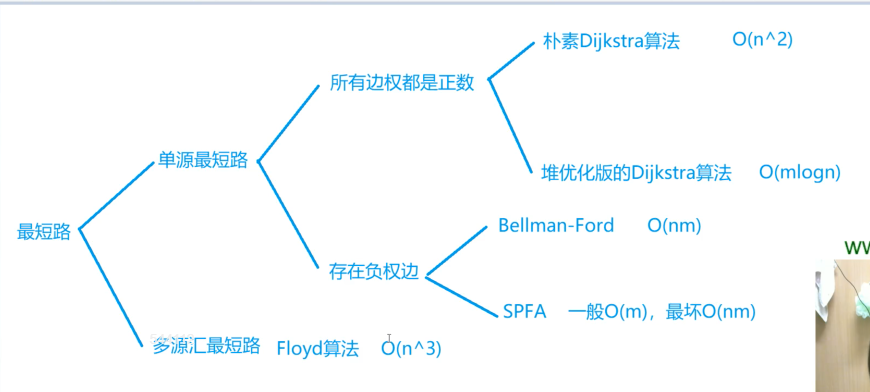
- 朴素Dijkstra算法适用于稠密图
- 堆优化版Dijkstra算法适用于稀疏图:用优先队列
- 稀疏图用邻接表存
- 稠密图用邻接矩阵存
- 没有负环才能用SPFA
朴素Dijkstra算法
- 找到路径最短的点,标记一下
- 用这个点更新其他的路径
##include<iostream>
##include<cstring>
##include<algorithm>
using namespace std;

const int N = 510,M = 1e5 + 10;
int h[N],e[M],w[M],ne[M],idx;
int n,m;
int dist[N];
bool st[N];

void add(int a,int b,int c){
    e[idx] = b,ne[idx] = h[a],w[idx] = c,h[a] = idx ++;
}

int dijkstra(){
    memset(dist,0x3f,sizeof(dist));
    dist[1] = 0;
    for(int i = 1;i < n;i++){
        int t = - 1;
        for(int j = 1;j <= n;j++){
            if(!st[j] && (t == -1 || dist[t] > dist[j]) )
            t = j;
        }
        if (dist[t] == 0x3f3f3f3f) break;
        st[t] = true;
        for(int j = h[t]; j != -1;j = ne[j]){ // j为idx
            int k = e[j]; // k为节点编号
            dist[k] = min(dist[k],dist[t] + w[j]);
        }
    }
    return dist[n];
}

int main(){
    cin >> n >> m;
    memset(h,-1,sizeof h);
    int a,b,c;
    while(m--){
        cin >> a >> b >> c;
        add(a,b,c);
    }
    int res = dijkstra();
    if(res == 0x3f3f3f3f) cout << -1;
    else cout << res;
}
堆优化版
- 找到路径最短的点,标记一下(用优先队列直接找到)
- 用这个点更新其他的路径
##include<iostream>
##include<cstring>
##include<algorithm>
##include<queue>
using namespace std;

const int N = 2e5 + 10,M = 2e5 + 10;
int h[N],e[M],w[M],ne[M],idx;
int n,m;
int dist[N];
bool st[N];

typedef pair<int,int> PII;

void add(int a,int b,int c){
    e[idx] = b,ne[idx] = h[a],w[idx] = c,h[a] = idx ++;
}

int dijkstra(){
    memset(dist,0x3f,sizeof(dist));
    dist[1] = 0;
    priority_queue <PII,vector<PII>,greater<PII>> heap;
    heap.push({0,1});

    while(heap.size()){
        auto x = heap.top();
        heap.pop();
        if(st[x.second]) continue;
        st[x.second] = true;
        for(int i = h[x.second];i != -1;i = ne[i]){
            int j = e[i];
            if(dist[j] > x.first + w[i]){
                dist[j] = x.first + w[i];
                heap.push({dist[j],j});
            }
        }

    }
    return dist[n];
}

int main(){
    cin >> n >> m;
    memset(h,-1,sizeof h);
    int a,b,c;
    while(m--){
        cin >> a >> b >> c;
        add(a,b,c);
    }
    int res = dijkstra();
    if(res == 0x3f3f3f3f) cout << -1;
    else cout << res;
}
Bellman-ford算法
- 先循环k次**(循环k次就是找到不少于k条边的最短路径)**
- 需要拷贝上一次遍历的结果
- 内循环遍历所有的边,更新每个点的最短路径
SPFA算法
- 初始化所有数组
- 当队列不空的时候取出队头元素并更新其他点的路径
- 更新过的点放到队列里面,不能重复放,用st数组判断点是否已经放进队列
##include<iostream>
##include<queue>
##include<cstring>
using namespace std;
const int N = 1e5 + 10;
typedef pair<int,int> PII;
int n,m;

int e[N],ne[N],idx,w[N],h[N],dist[N];
bool st[N];
void add(int x,int y,int z){
    e[idx] = y,ne[idx] = h[x],w[idx] = z,h[x] = idx ++;
}

int spfa(){
    memset(dist,0x3f,sizeof dist);
    queue<PII> q;
    dist[1] = 0;
    q.push({0,1}); // 最短距离是0,编号是1
    st[1] = true;
    while(q.size()){
        auto t = q.front();
        q.pop();
        int dis = t.first,vec = t.second;
        st[vec] = false;
        for(int i = h[vec];i != -1;i = ne[i]){
            int j = e[i];
            if(dist[j] > dist[vec] + w[i]){ // 这里不能用dis,因为dist[vec]在循环的时候可能会更新
                dist[j] = dist[vec] + w[i];
                if(!st[j]){
                    q.push({dist[j],j});
                    st[j] = true;
                }
            }
        }
    }
    return dist[n] >= 0x3f3f3f3f / 2; // 可能有负权边
}

int main(){
    memset(h,-1,sizeof h);
    cin >> n >> m;
    while(m--){
        int x,y,z;
        cin >> x >> y >> z;
        add(x,y,z);
    }
    if(spfa()) cout << "impossible" << endl;
    else cout << dist[n] << endl;
判断负环
可以直接维护一个cnt数组,记录最短路径的边数,当边数大于节点数,说明有负环
需要将所有点都加到队列里面
dist数组并不是用来记录最短路径的,是一个工具数组,因为只要有负权环,dist存的数就会越来越小,因此其初始值也是任意的
##include<iostream>
##include<queue>
##include<cstring>
using namespace std;
const int N = 2010, M = 10010;

int n,m;

int e[M],ne[M],idx,w[M],h[N],dist[N],cnt[N];
bool st[N];
void add(int x,int y,int z){
    e[idx] = y,ne[idx] = h[x],w[idx] = z,h[x] = idx ++;
}

bool spfa(){
    queue<int> q;
    for(int i = 1;i <= n;i++){
        q.push(i);
        st[i] = true;
    } // 最短距离是0,编号是1
    while(q.size()){
        auto t = q.front();
        q.pop();
        st[t] = false;
        for(int i = h[t];i != -1;i = ne[i]){
            int j = e[i];
            if(dist[j] > dist[t] + w[i]){ // 这里不能用dis,因为dist[vec]在循环的时候可能会更新
                dist[j] = dist[t] + w[i];
                cnt[j] = cnt[t] + 1;
                if(cnt[j] >= n) return true;
                if(!st[j]){
                    q.push(j);
                    st[j] = true;
                }

            }
        }
    }
    return false;
}

int main(){
    memset(h,-1,sizeof h);
    cin >> n >> m;
    while(m--){
        int x,y,z;
        cin >> x >> y >> z;
        add(x,y,z);
    }
    if(spfa()) cout << "Yes" << endl;
    else cout << "No" << endl;

}
Floyd算法
- 用邻接矩阵存
- 三层循环,最后邻接矩阵存的就是最短路径长度
##include<iostream>
##include<cstring>
##include<algorithm>
using namespace std;

const int N = 210;
int n,m,k;
int d[N][N];


void floyd(){
    for(int k = 1;k <= n;k ++){
        for(int i = 1;i <= n;i++){
            for(int j = 1;j <= n;j++)
            d[i][j] = min(d[i][j],d[i][k] + d[k][j]);
        }
    }
}

int main(){
    memset(d,0x3f,sizeof d);
    cin >> n >> m >> k;
    for(int i = 1;i <= n;i++) d[i][i] = 0;
    while(m--){
        int x,y,z;
        cin >> x >> y >> z;
        d[x][y] = min(d[x][y],z);
    }
    floyd();
    while(k--){
        int x,y;
        cin >> x >> y;
        if(d[x][y] >= 0x3f3f3f3f / 2) cout << "impossible" << endl;
        else cout << d[x][y] << endl;
    }
}